


Own
a Piece of California
State History All
of our wood is
clear all heart
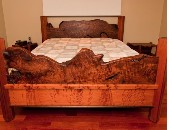
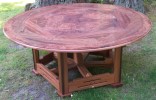
salvaged old growth
redwood. This salvaged
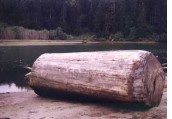
sunken redwood
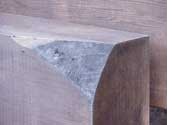
has ax-shaved ends,
meaning it was
cut before the
late-1800s. Originally |
Fine
Craftsmen and WoodworkersWe
gladly interface
with owners, contractors,
architects, builders,
designers and/or
their agents to
provide you our
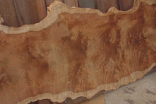
beautifully colored
salvaged redwood.
We know old growth
redwood and what
it can do. |
Brewery
Gulch Inn |
Myrtlewood
Available |
Customer
Reviews |
In
The News |
The
Salvage Story |
Green
Benefits and Durability
of Redwood |
A River Runs Through It—by Eileen Hansen
 In
June, 2001, the San Francisco Chronicle Sunday
Magazine published an article about this redwood, its history from
1849, and the salvage story:
In
June, 2001, the San Francisco Chronicle Sunday
Magazine published an article about this redwood, its history from
1849, and the salvage story:
A man's journey from doctor to innkeeper in Mendocino County began with dredging old logs out of Big River.
On a typical rainy winter night in 1995, Dr. Arky Ciancutti did what many Mendocino residents do in such conditions—he sought shelter. Holed up in Dick's Place, a down-home bar nestled among scented candle shops and tourist T-shirt retailers, Ciancutti was planning to have a few beers and play a little pinball when two rough-hewn men sat down beside him.
"These guys were straight out of ZZ Top," says Ciancutti. "Long beards, lumberjack caps, camouflage coats and Arkansas accents so thick you could cut 'em with a knife. Definitely not local."
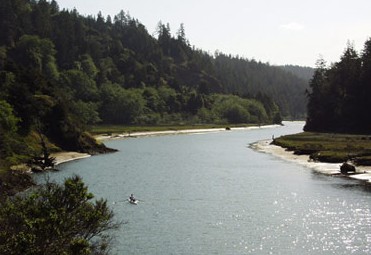
But Ciancutti felt like he knew them. He'd been watching them work for more than a month, retrofitting the bridge that spans Big River, just south of town.
The men were building a cross-hatch support system to earthquake-proof the bridge, and Ciancutti, a self-confessed "wood freak," was particularly interested in their skill at fitting the broad fir beams.
Beers were poured and stories flowed, and after an hour or two, one of the men leaned a little closer to Ciancutti. In hushed tones he passed on some information that to a wood aficionado was the equivalent of a detailed map to the Holy Grail. He told Ciancutti that they'd been drilling deep into the riverbed—as far down as 38 feet—and they were still bringing up wood shavings.
"Does it look like redwood?" asked Ciancutti. The man nodded, and from that moment, Ciancutti's life took a different course.
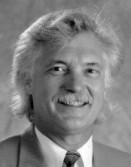 But he was used to his life's suddenly taking new courses—he'd been working as an emergency room doctor for years, when one day in 1977 he decided to buy a run-down farmhouse in Mendocino, which he later refurbished as an inn (doing a little management consulting in Marin to ensure that ends met). To the casual onlooker these might appear to be curious career moves; to Ciancutti, they made perfect sense.
"I learned a lot about teamwork in the emergency room," he says. "I wanted to transfer that same knowledge to business." Hence, consulting. As for the farmhouse, that was a little less logical. Ciancutti says he knew the minute he saw the land that he had to buy it. A pastoral 10-acre site overlooking the coast, it has a rich history reaching back to the 1800s, when it was the county's first commercial vegetable farm, dairy and brewery. Ever since he was a child, Ciancutti had dreamed of living in a house near an orchard and by the ocean. This was it.
Ciancutti, then a single dad, moved to the farm with his young children. He met a woman named Mac; they married and combined families. Life was rosy for a few years, and then Mac was diagnosed with cancer. The family moved back to the Bay Area for Mac's treatment, and Ciancutti converted the Mendocino farmhouse into an inn as a place holder for a life that he and Mac desperately wanted to return to. Mac died within a year, but Ciancutti was determined to get back to the spot he considered home.
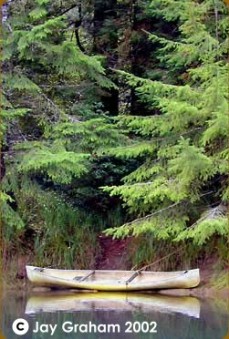 "There is something incredible about that land," says Ciancutti. "It has an amazing microclimate—anything can grow there. I can prune a fuchsia, stick a cutting in the ground, and it grows."
Ciancutti had left more than just fond memories in the Mendocino farmland; an avid gardener, he'd planted hundreds of heirloom roses throughout the property, thousands of daffodil bulbs, colorful fields of rhododendrons, and garlic that could be traced back to seeds brought over by his Italian ancestors. Ciancutti dreamed of returning to Mendocino, resettling in the farmhouse, and building another inn on the property—but not just an ordinary inn.
"I wanted to create a place that was as beautiful as the setting," says Ciancutti. "I really didn't know how I'd do it, but when I heard about the wood, it all became clear."
Ciancutti figured that if the logs buried in the watery depths of the Big River were redwood, they were most likely first-growth redwood felled in the days when Mendocino was a bustling mill town.
Back in 1851, Harry Meiggs, founder of San Francisco's Fisherman's Wharf, sailed to Mendocino with a full sawmill. Recognizing the opportunity that lay in the area's dense redwood forests, he set up the mill and made Mendocino the Bay Area's primary source for lumber. For the next 30 years, business boomed and more than 27 dams dotted the Big River's waters. These dams caught and held the logs until enough rainwater fell to drive them on to Meiggs' mill at the river's mouth. Many of the best bottom-cut logs—some of them up to 12 feet in diameter—sank to the river floor, where they remained and got buried.
Ciancutti wasn't the first to hear of the logs, but when it came to salvaging the wood, he was among the most determined. Pairing up with a friend, Ciancutti worked through the winter, when the tides were right and the river was swollen with water. Using only a skiff, a winch and their own strength, they dredged the murky waters of the Big River.
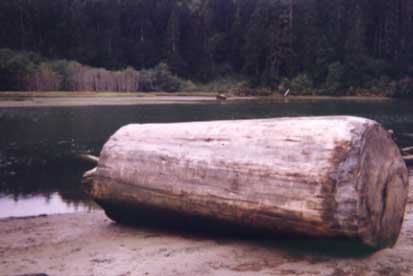 Prize pieces of salvaged wood are known as pumpkins, and right from the start, Ciancutti and his friend were finding them. "When I saw that some of the wood had ax-shaved ends, I knew that it had been cut before the late 1800s, when the Raker Tooth saw was invented," says Ciancutti.
There were a handful of others on the river with the same idea. Some found logs more than 16 feet in diameter; Ciancutti felt lucky to find a few that were 7 feet across. Several of his prize finds still have the branded initials on the bottom, intended to identify their owners once the logs floated down river to Meiggs' mill. Altogether, Ciancutti and his friend salvaged nearly 30,000 board feet. Between salvaging, buying and trading—sometimes with the men from Arkansas—Ciancutti had amassed more than 180,000 feet of first-growth redwood by mid-1996. He was ready to quit.
His timing couldn't have been better. Word of the salvaging operations for "sinker logs" had reached the California Fish and Game Department. In response to a 1998 court case, the department decided that any salvaging project that had the potential to alter the stream bed had to undergo environmental review. According to Steven Rae, Timber Harvest Program supervisor for the Fish and Game Department, whatever wood had been there for the taking was already gone.
"There was a small window of time when the value of the wood and the relatively easy access to these sinker logs all came together to form a kind of boom time," says Rae. "That's pretty much over now. It would take some serious equipment at this point to salvage what's left. The economics just don't work out."
Still, Ciancutti's buried treasure has held its value. Not only is the wood extraordinarily beautiful, with its tight grain and unusual variegated shades of blond, burgundy and rich cinnamon brown—a result of more than 100 years in the mineral-rich water of Big River—but with it, Ciancutti has built his dream inn.
The new Brewery Gulch Inn, which opened last month [May, 2001], is a luxury 10-room bed and breakfast that showcases the wood in its soaring lobby, private decks and picture windows framing dramatic ocean views. A French-trained chef prepares gourmet breakfasts and afternoon hors d'oeuvres. Guests can sample local wines at the wine bar, which also features the wood. Ciancutti figures that he's used a third of his "eco-salvaged" wood to build the inn; he's hanging on to the rest to build a small conference center and greenhouse.
"I wanted to create a place where people could feel like they're getting a month's vacation in a few days," says Ciancutti. "I couldn't have done it without the wood. It's the perfect bridge between the area's past and its present."
The Brewery Gulch Inn
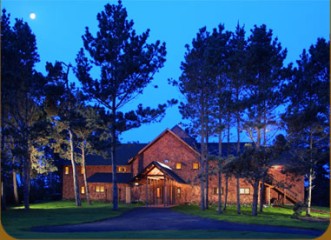 The new Brewery Gulch Inn is located on the Pacific Coast Highway, approximately a three-hour drive from San Francisco and just five minutes from "downtown" Mendocino. Rooms sleep two to four persons. The inn is also available for small conferences, weddings and special events. (The Inn is now owned and operated by Guy and Sarah Pacurar.)
For more information, visit www.brewerygulchinn.com, or call (707) 937-4752.
Activities on Big River
Exploring the Big River is a great way to enjoy Mendocino without the crowds. At Catch a Canoe & Bicycles Too! (707-937-0273), you can rent kayaks, outrigger canoes and bicycles at an hourly rate. The inn can arrange a picnic lunch to take along, and there are plenty of places to stop and relax. If you're lucky, you might see a few beavers doing some serious salvage logging on the Big River.